Part One: The Gauntlet
This blog post has a folk tale with a very interesting title and a very disturbing endorsement to thank for its existence. It’s a combination that leaves me feeling both baited and irritated at once.
Today, we are skimming the surface of the well-thumbed and deservedly scalded subject of heroes. As a topic, they are as contentious as they are necessary, as self-fulfilling as they are self-effacing. As a word on the other hand, their etymology is markedly less so in all regards.
“Without knowing to what we lay claim, is it not dangerous to want it?”
When I was a student, I headed a discussion (with admittedly limited success), on the nature of this mythos; the hero. Earlier even than that, I turned my hand (heavy-handedly) to poetry dissecting this same elusive form. At the time my aim was simply to level the playing field (or as the bards would have it, battlefield), to destabilise, and strew the eligibility of heroism accessibly into the everyday. I leave it up to you to decide if under the hood this post represents merely a continuation of that ultimate goal, but in my own opinion it seeks something more offensive entirely: not to widen the definition of a hero, but to critically replace it. Not to claim it but to denature it phenomenologically. Without knowing to what we lay claim, is it not dangerous to want it?
Historically, as a general understanding in the English language, the term ‘hero’ was a masculine frame of measurement, or reference. Where women are assigned it, it is not an absence from this understanding but arguably a reinforcement of it -“adjectivising” it- to allow for the application of a relatable image. This is, of course, how all words with majority use-cases work. And ironically for lack of a better one, I do choose the word “assigned” tentatively, without the evidence to make assumptions on agency.
It was also, by many accounts, a violent one. Direct links are made between these masculine archetypes and their physical strength. Its semantic associates, words like ‘strength’, ‘courage’, ‘warrior,’ and fascinatingly ‘free man’, shift subtly into “the exhibition of bravery” and, with morbid self-awareness, even the principal male protagonist in a play, story, or performance, in the definition of hero [1]. Blurring the line between divinity and mortality they draw from their allegedly celestial sources a telling array of familiar characteristics. Like cards in a stack, little were names like Hercules, Arthur, the Feinne, Rustam, and others besides distinct from their weaponry and war. There are exceptions to every argument, and this argument is no exception to that. Plentiful examples exist, I am certain, of individuals blessed with the charmed status of hero without an erstwhile reputation for destruction, however, along the scale of either quantity or popularity, these still tend to sit in the region of minority, and since the purpose of this article is to address the more alarming consequences of our trusting adoption of the word hero, it’s time is better spent challenging the gauntlet majority.
“It is an old nod to an old truth, that othering is most easily done visually, where no effort is required to confront uncomfortable commonalities between monsters and men.”
We might choose to look at this, quite literally, in another way. Be it by means of their oral nature or not, heroic characters are qualified by their visibility; onstage, psychologically, verbally or physically. Making them subconsciously, I might add (and in this regard not exclusively historically), an incredibly human one. Minotaurs and krakens, Medusa and Errour, Yeti and Al, and yokai of all flavours attest to the unforgivable crimes that run horizontal across their physical form. It is an old nod to an old truth that othering is most easily done visually, where no effort is required to confront uncomfortable commonalities between monsters and men. And specifically men, which turns out to be key, largely because the frustrating patterns that emerge place them in the spinning heart of the web as both givers and recipients, tellers and listeners, not only both sides of every equation but also their solvable result. This is not intended as a hateful discussion of men, only as a contradiction of dangerous assumptions before we draw on ourselves the consequences of making them in the granular way consequences are generally distributed. What do I mean? Let’s recruit the most dramatic and recognisable hero-monster duality to undergo it’s redemption arc in modern literature. The knight and dragon.
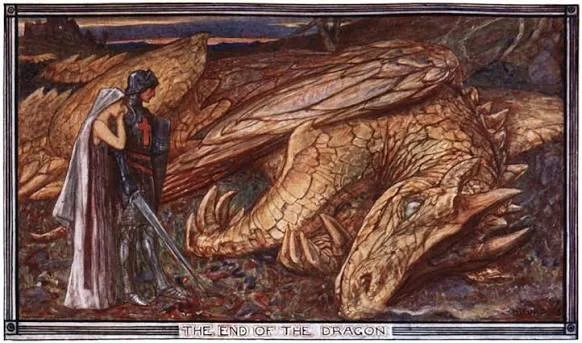
Fig. 1: Una, The Red-Crosse Knight and the Death of the Dragon- illustration by Henry Ford in The Red Romance Book, edited by Andrew Lang
Part Two: The Daughter of The King Under the Waves
This began with a fairytale, however. An elegiac one in which the loser is feminine. I’ve wandered, mythologically speaking, freely till now, but I promised that fairytale so I promise likewise to keep this last criticism aimed squarely at its target. And not merely to spare your attention span, but also out of a recognition that in reality, we need be calculated in considering any discourse we have approached through the double-glazed filters of time and textual translation. Not to allow for excusals that even posterity does not sanctify, but to concede the influence of interpretation, as rotted organic material in a burial site that obscures our view. The understanding of the audience at the time of telling is not an aspersion we can always reasonably cast, but by the same token, respecting the possibility of interpretations past requires that we address possible interpretations present. It is in this spirit that I write to you now with a measured defiance towards the story that follows. Because, like all myths and legends, the longevity of our heroes relies entirely on our willingness to preserve it with every repetition and retelling. They are a force of popularity, and in return we ride the wave of their accrued repute to grasp our own recognition. A fair transaction it may well appear, yet contractually, that doesn’t make it any less our responsibility to check the clauses in the terms we use, because even for insinuations made unwittingly, the shares of repute are indiscriminate. So I present, The Daughter of the King Under the Waves (to save time, I won’t relate the entire story here, I refer you instead to the internet, or a collection of folk tales similar to the one in which I met her myself [5]).
“The longevity of our heroes relies entirely on our willingness to preserve it.”
In the story of The Daughter of the King Under the Waves, our first arterial-red flag rises in the opening scene, when a purportedly ‘weird woman’ is refused shelter from a storm on the grounds of her ugly strangeness, with long and wild hair down to her heels. This, it is revealed later, has been inflicted as the result of a terrible enchantment rather than any real deficiency in her appearance, far from convenience (or worse, mercy), the spell-ification provides a convenient scapegoat, and renders any derisory responses she previously received ultimately inculpable. Naturally. Our hero in this instance, Diarmid of the Feinne, distinguishes himself somewhat underwhelmingly with a valiant show of common decency, allowing her in from the rain. If, as the story claims, this stems from his innate desire to ‘do good’, it is not innate enough to preclude a little light name-calling on the threshold first, apparently. Even then this mysterious woman begins to become something of a male fantasy, eager to share his blanket once admitted into his hall, only to be paternally repelled. Not that this holds, since it is a fancy that continues into the boon of her gratitude. Not only as she sleeps does she turn out to be uniquely beautiful in reality, a fitting consolation for his reluctant indulgence, whatever magic she moves within is determined to please him beyond reproach. On waking she opportunely offers him castle (and at his request her instalment in it alongside him), bitch hound and litter of pups like something out a comfortable feudal dream. And to her existing charms is added material profitability. It is a gift, certainly, so can he be blamed? From a writer’s perspective, equally certainly, since the moral high ground gets noticeably shakier when we assess the entitlement encouraged by a narrative engineered to provide an individual with more than they deserve to receive under the guise of indebtedness for charity. Particularly if one considers that the metaphorical scales of proportionate returns seem to already be set in his favour (by which I mean being relieved of the trial of her alleged ugliness after one night of endurance as a grace to himself, rather than to her, who had suffered seven years of it).
Collected Sources:
‘Hero’, Etymonline, https://www.etymonline.com/search?type=name&q=hero’, [accessed 18/11/26]
Larrington, C, The Little Book of Dragons, (The British Library: London, 2025), pp 32-54, 59-60, 68, 76-77
Montogmerie, N. and Montgomerie, W., The Folk Tales of Scotland, (Birlinn: Edinburgh, 2005), pp. 239-246
List of Figures:
Ford, H., ‘The End of the Dragon’, in Lang, A. (ed.), Lang, L, The Red Romance Book, (Longmans, Green and Co: London, 1905) Available for view on https://pressbooks.openedmb.ca/artisticliteracies/chapter/in-the-air-dragon-and-winged-mythic-creatures/[Accessed 18/11/26]. Or on Project Gutenberg at http://www.gutenberg.org/files/24624/24624-h/images/f124-full.jpg
Rackham, A., ‘The Kings Only Daughter had been Taken by a Dragon’, in Grimm’s Fairy Tales, (William Heinemann: London, 1925). Available to view at: https://www.imagesonline.bl.uk/asset/143198 [Accessed 18/11/26]
Rackham, A., ‘The Dragon Fafnir Guards the Gold Hoard’, in Wagner, R., Seigfried, (Heinemann: London, 1911). Available to view at https://commons.wikimedia.org/wiki/File:Ring41.jpg [Accessed 18/11/26]
Burne-Jones, E., ‘Emelye in the Garden’, in Ellid F.S. (ed.) ____, The Works of Geoffrey Chaucer, (Kelmscott Press: London, 1896). Available to view at Goodman, M, ‘The Kelmscott Chaucer Online’, 2023, https://www.kelmscottchauceronline.org/illustrations [Accessed 18/11/26]
Batten, J, ‘Child Wynd Thrice kisses the Laidly Worn and rescues his sister the Princess Margaret’ in Jacobs, J, English Folk and Fairy Tales, (Putnam’s Sons: New York, n.d.). Available at https://www.oldbookillustrations.com/illustrations/laidly-worm/ [Accessed 18/11/26]
Firstly, perspective demands that we run the hairline path on one side of which the dragon is only a symbolic icon, thus subjected to a technique that by definition simplifies its victims to recycle their sense of self. But while the choice of emblems may be the product of a loop in which physical observations inform folkloric decisions, just as incontestable is the fact that their new identity is abstract. A sentiment, a possibility, an intangibility like love, peace, grief, prosperity. The mores of a collective psyche can be analysed in the symbols they alter and select, a process not intended to dismantle the construct of symbolism itself (a sentiment this article shares), but to ensure that in changing the palpable face of the immaterial, practical symbolism remains true to it’s own purpose in portraying the entity it first sought to represent. Not only are the vessels freed up to nuance again, but the amorphous motif, in whichever form it may appear, is still commended or condemned. Such is the process modernity has brought to bear on the dragon in anglophonic mainstream media.
Merlin, Eragon, Temeraire, Game of Thrones and the Fourth Wing may have reclaimed and refashioned these otherworldy reptiles into believable allies (even household pets) for audiences now rejecting the notion of a creature whose innate malice stems from its non-hominin identity, but delve deeper below the newly repainted surface of dragonalia and we have a glittering exemplar of the way a very particular male self is prescribed, justified, self-fulfilled and happily reinforced within not only the archetype of epic darkness and light, but also in the hapless no-goods, bystanders, and innocent scenery in between. Every device utilised in tales of draconic victory and defeat is a means to an end frighteningly similar to the real-world desires of would-be legendary parallels. Broken down and acidly dissolved to their shrivelled, stubborn, straightforward core, dragons and daring quests and dreamy means of inflicting damage are embroidered frills to gentrify the same predictable desires for gold, soldiers and often women in an embarrassing attempt to make them appear less pitiful than they are. Thinly so. A means by which certain men and masculinities define, validate, and then receive exactly what they want. Dragons are a staple of fantasy today in a heavily anthropomorphic way that may stagger precariously towards fetishes in other regards certainly, but it places an entirely more carnal spin on the use of the word to examine how they were purposefully disfigured to satisfy an insecure male ego, before that.
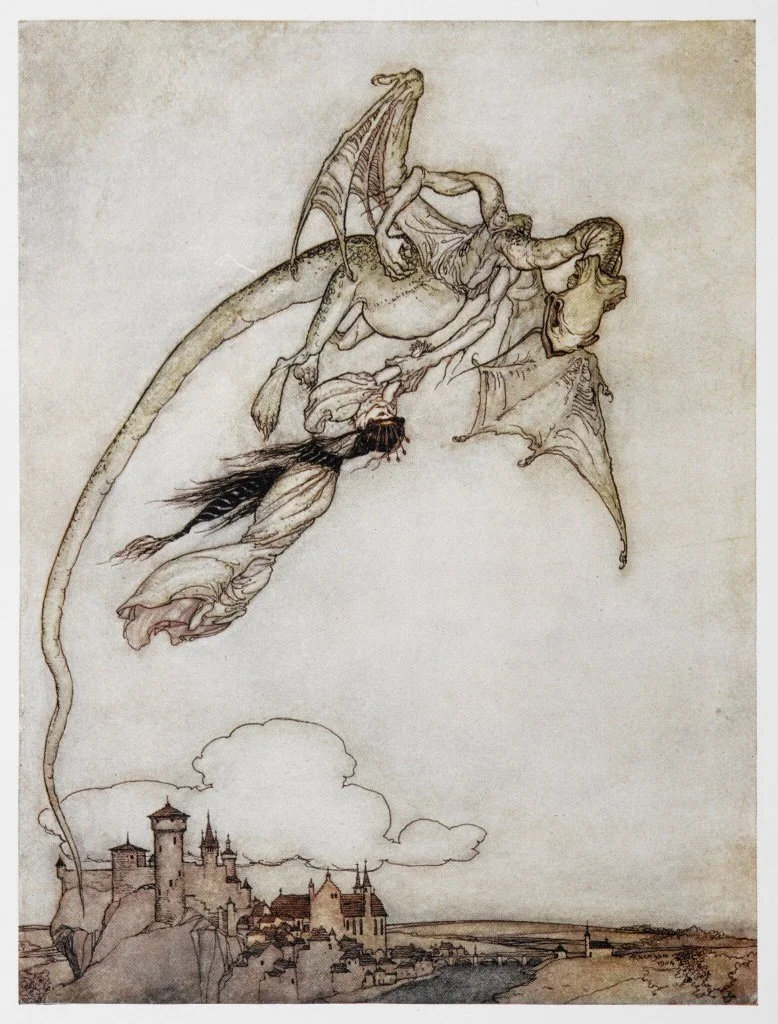
Fig 2: “The Kings only daughter had been carried off by a dragon”- Illustration by Arthur Rackham, from The Four Clever Brothers by the Brothers Grimm.
Take Thora, of Norse myth, now that she is of marriageable age she is promised like a piece of the gold that she is served up alongside to the hero who can violently rid (her apparently, but her father more probably) of the dragon that she tended to as a child, and is now grown inconveniently large enough to prevent anyone but her entering her quarters. Not only is she the one punished by the removal of her enviable privacy for the presence of a creature her father himself maintained and another gave to her as a gift in the first place, but there comes the apparently implicit assumption that she will consider it a reward to be saddled with, of all people, the one responsible for slaughtering it. It does not, after all, appear to harbour any ill-will toward her, so what ill-will can we assume she bears it in response? Maud in Herefordshire, meanwhile, ‘is grief stricken by the loss of her dangerous friend’, the account takes care to mention, when the wyvern she raises from infancy turns savage (notably after having first been attacked itself) and is dispatched of by some young man or other (for it is not savagery to use a spear instead of teeth). Whether his nobility is bestowed before or after this brutal act is usually open to debate. Her suffering less so. Others are in for worse fates, Allison Gross and Lady Margaret of Bamburgh are in fact women transmuted into dragons themselves, the paragon of hideousness (fittingly ensorcelled out of jealousy by a step-mother allegedly “hideous” herself, in Margaret’s case. Since perish the thought that women do other than assault each other over the single characteristic through which many tales assign them any value: their physical appearance). Doomed to await rescue only through the legitimately dubious means of a kiss from their would-be murderers, heroic simply by daring to approach the female beast, ‘overcome his disgust’ and deign to bestow upon the physically undeserving creature a token of his salvation-adjacent affection. The poor daughter of king Ypocras meanwhile, is so unattractive as a dragon that she cannot tempt even that for the sake of her freedom, even after painstakingly explaining the cold and unemotional logic of this need, as designed by ridiculous expectation to humiliate her. As if, even in the torment of having been cursed already, the moral assistance of a man is something these women are still required to shape to his sensibilities in order to have earned the right to. Never is the simultaneously honest reverse voiced that grizzly, sweaty, squeamish mercenaries may well be so repulsive in every respect that even a dragon would not kiss them.
Defense of gains won is unnecessary, though, since Diarmid is to remain unsatisfied anyway, and be given yet more. By now I’d consider you justified in suspecting this the clucking corrective sort of didactic that delivers warnings against greed, folly and just deserts with all the subtlety of a sledgehammer swung by a drunk to be wholly understandable. But you would be wrong. I almost wish that it was. It turns out Diarmid is lonely, not for the company of his…her position at this point is unclear, as no mention of marriage has actually been made, leaving this dubious living arrangement and her rights in it officially anyone’s guess…but for his Feinne. It was from a professor of language and linguistics that I was first confronted with the concept of the bent of male homosocial rivalry in legend and folklore, such that the preoccupation of plot was not the prize but the competitors. In stunning irony, the hand of the maiden was incidental, significant only as far as arranging the battle between knights necessary to win it. Now, interpreting Diarmid’s melancholy as a longing for one’s community and people makes it a plea we should probably be willing to accept, especially as in this version of the tale the concession comes not from complaints made by Diarmid himself. Even were it not for rebuttals in the general vein of having one’s cake and eating it however, since the Feinne are, in most legends, a male band of just that variety of hero normally reliant on grandiose othered violence, they draw the associated fire, and Diarmid’s desire to be with them creeps innocuously towards a grass-was-greener hope to return to a carefree life of camaraderie. Even more alarming is that his immediate concern, once granted leave to return to return to her only at night, is not for her loneliness or employment during the daylight hours, but the well-being of his newly acquired dogs in his absence. Their treatment as the story progresses, to the point that when he finds her dead, he will carry the corpse of his bitch over his shoulder out of a keen sense of grief, makes it harder to deny that all comers, be they animals or tribesmen, were settled on a rung of the ladder higher than the lady sufficiently supporting his relationship with both simultaneously. Perhaps the driving edge was to discourage man from choosing worldly riches over the ascetic and glorious existence of the warrior, though this fails to explain why it need be done at woman’s expense, in such a way that makes of the Daughter of the King Under the Waves, an accessory.
“The hand of the maiden was incidental, significant only as far as arranging the battle between knights necessary to win it.”
I will offer Diarmid a little credit. After being handed all on a golden platter with silver spoon in attendance in case of emergency, and still succeeding in disobeying the singular request his enigmatic woman (who remains nameless, it is worth pointing out) makes of him in return, she leaves and he does go after her. I believe we are meant to deduce that in her leaving him after his disobedience, his penalisation is somehow implied, even when it is she who consequently loses a potential home, falls ill and is denied her lifeblood in leaking clots (grisly, right?) as a result of the whole affair, topped off by a plot that has meticulously turn-tailed its audience to deposit them in yet another situation where her survival leaves her fatally dependent on his help. With a smug flourish that leaves us detangling the lines of accountability in the snarl of their relationship. Now on his valiant rescue mission from, well, himself, the woman Diarmid meets along the way, strong enough to carry him on her back is denounced as “crazy looking”, but the tiny red man on whose head he can stand to cross rivers is nothing of particularly divergent note. I would call it a riddle, if it weren’t for the fact that even riddles are devoid and insoluble if you change their rules half way through.
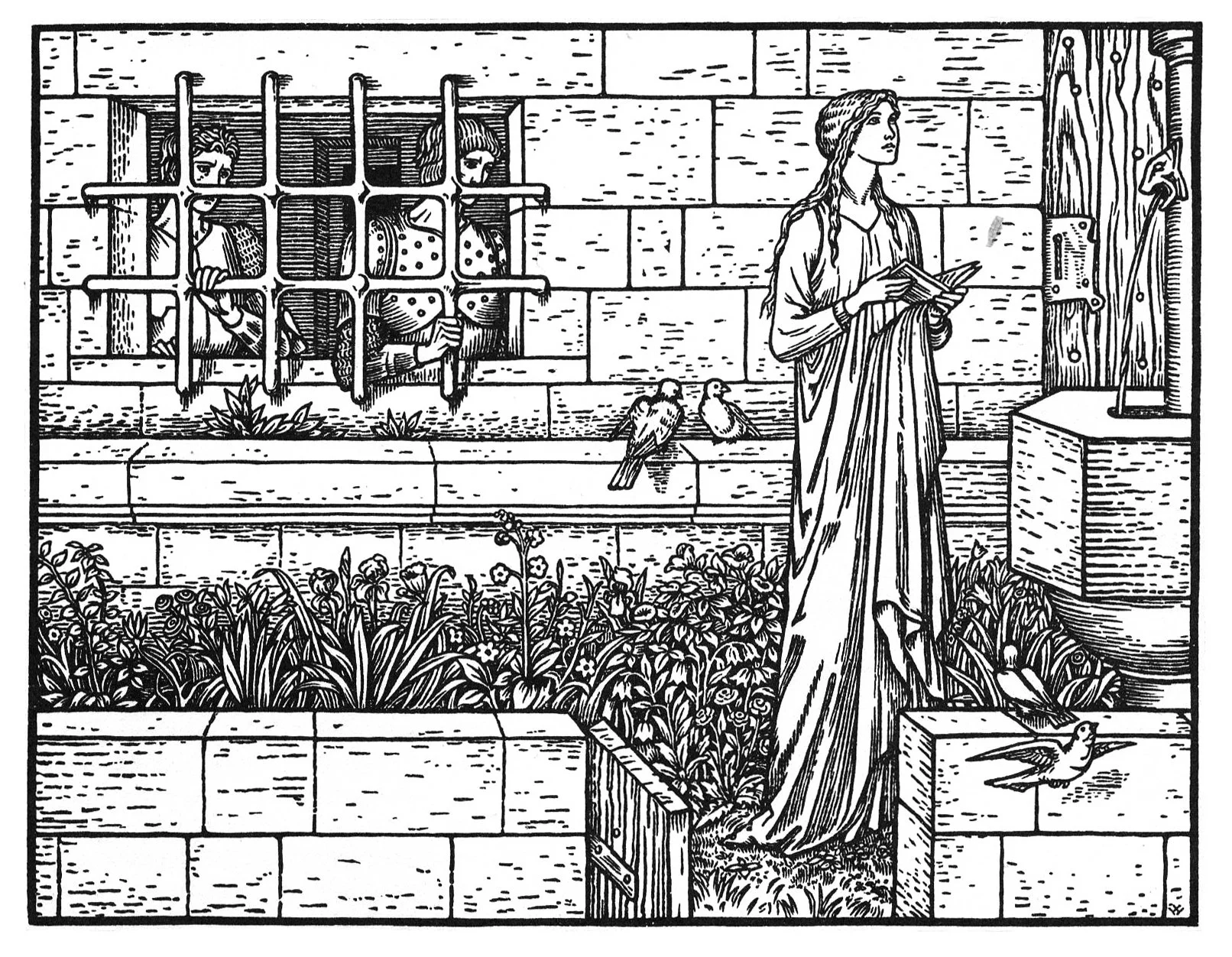
Fig 4: Emelye, Palamon and Arcite- Woodcut of The Knight’s Tale in the Kelmscott Chaucer
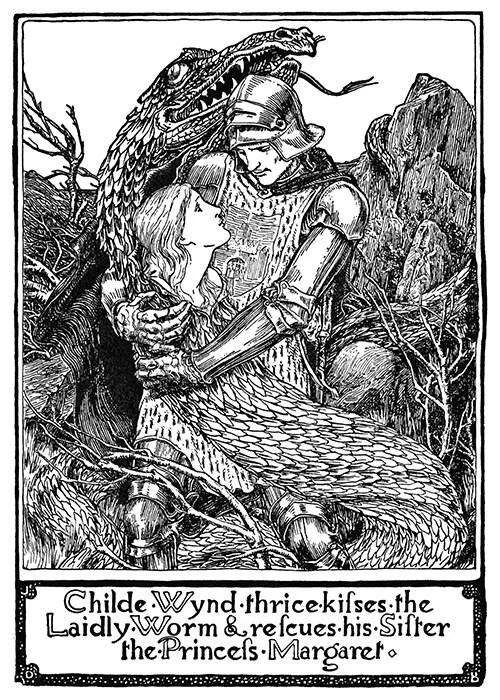
Fig 5: See above
“The dragon, as the pinnacle of imagination in each scenario in which it appears, desperately begs us to ask.”
Such are the pale and pointless protagonists, obvious you might argue, but no less enraging for that. If so, then you may find more interesting the thin cords of similarity that truss the antagonists in these grim and gritty sagas. The dragon, as the pinnacle of imagination in each scenario in which it appears, desperately begs us to ask lest we be imagined out of our own existence likewise: wonder not what is imagined as much as this, whose imagination? Let’s look at Fafnir the fire-drake, distinguishing himself amongst folkloric dragons for that self-same characteristic. In one sentence he makes my point for me, it is baked in fire, flesh and precious metal into his very tale to embody the singular confession that we might amuse ourselves a further few hours intuiting the deliberateness of: Fafnir is a dragon who was once a man.
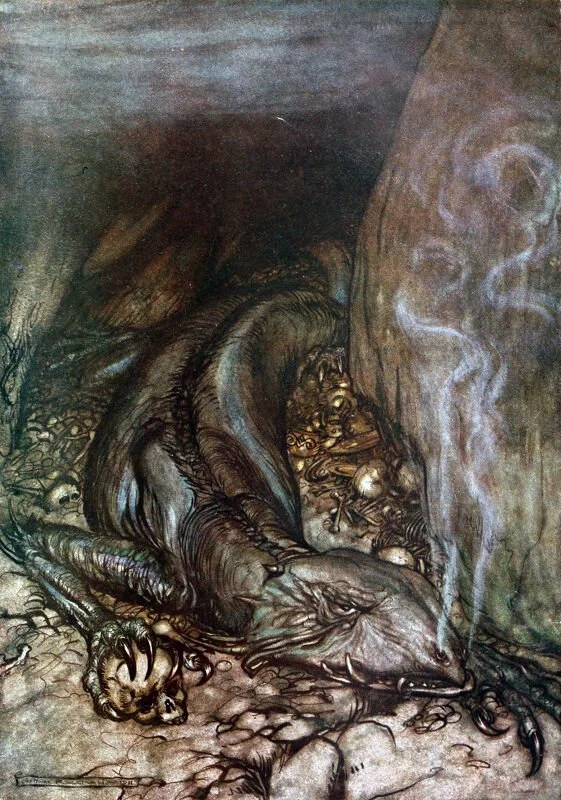
Fig 3: Fafnir guarding the hoard- Illustration by Arthur Rackham in The Ring of Niblung by Richard Wagner
And not in such a wretched, needy way as any woman is, to not only bear her newly dangerous potential as a burden but also be crippled out of removing it and destined to yearn for the moment of release until her dying breath anyway, regardless of whether or not there happen to be any itinerant men hanging around in the wings (no pun intended) honourable enough to oblige. Once dragon, sure, he probably relinquishes certain advantages reserved solely for mankind in its purest form, like the use of opposable thumbs perhaps, but not only is he mightier (currying even beneath an alien layer of scales, the currency of male violence), but he is in the end wiser and richer into the bargain. Before you raise it, yes, in all my facetiousness I understand that the thrust of Fafnir’s tale is to spiral from dragon to downfall, undeniably, and I do not suggest he is meant to be advantaged by the transformation, but that too is the precisely the point. The thrust of this article is in fact to dwell exactly on what is unmeant, and realised anyway. So in that spirit let us pause here and examine briefly. To remain on track with this train of thought is to find Ketos, Beowulf’s bane, the Mester Stoor worm, the Wawel dragon (by some narratives), scattered major and minor dragons of varied other cultures and traditions (not least among them proselytizing medieval Christendom), and of course, the infamous dragon of Silene, lying pointedly across that track and presenting us with a significant problem. A reputation as satanistic creatures obsessive over gold to the point of mutually assured destruction, violent in the extreme and lustful especially over “pure” women, protects its utter absurdity slyly through popular acceptance. We agree that these things are done. Therefore we do not need to ask quite why an entirely distinct species of creature would give a damn for valuables which, after closer inspection, turn out to be valuable in any sense of the world only to a society that is uniquely human. What wealth, one wonders, does a dragon derive from the same sources that humans do? None appear to materialise. We do not see iguanas going to war, or crocodiles counting coins on the riverbank, and we do not imagine that a stray dog that watches us across the street watches us lecherously. True, we don’t see trees that hold up the world, giants that become islands, leviathans in the bellies of oceans or soul-stealing storms either, but does it give us an excuse to invent them in a way that what we do see does not support even remotely? Or rather, supports elsewhere entirely? It may seem as though I am attacking the central channel through which any told tale holds the hypnotic power over humans that it does; through a relatable grafting of our own selves into unlikely circumstances for a colourful array of reasons; but I am not. My only purpose in exposing it is to return to the challenge that began this paragraph: whose imagination?
“What wealth, one wonders, do dragons derive from the same sources that humans do? None appear to materialise.”
I do not pretend that childishly simple binaries between men and women exist; that women do not desire, that the draw of fame, power, fortune and pleasure do not enact their pull upon them all the same, I only suggest a simpler comparison based on the fact that it is carelessly tossed in our immediate vicinity within so many of these stories. After which reading or recitation in which a usefully large hoard, along with its accessible, presumably willing(?), and attractive young woman is rightly won by the taking of life do the edges of the mirrored glass between dragons and the manly heroes who slay them begin to meet, even accidentally? How far can we truly distinguish between a monster and a man who so painlessly and easily inherits the ambitions of his monstrous predecessor? Who then, are truly our dragons intended as, and who then are they in the end, despite intention?
“Which is a more conscionable generalisation: to condemn all, or condemn none?”
Outside the door of the King of the Plain of Wonder, (the quest he is given to help the now-dying princess that serves, a cynic might say, to keep her an object of pursuit a little longer) he is required almost by rote at this juncture to slaughter countless men, defying odds beyond the bounds of even the suspension of disbelief for the ‘girl he loves most in the world’. Until all is proven futile anyway since his coming was foretold in prophecy and good old King Mag would have simply opened up had he just knocked. But it’s alright, no real harm done, widows will be widows after all, and tender emotions are obviously best demonstrated through the liberal spilling of blood, so long as it is indeed someone else’s. To return to my carefully laid precursors, you might protest that this is simply an objection developed out of the modern distaste for mass annihilation, in which case I too must return to questioning the need for contriving a situation in which it is made gratuitously necessary. Were there some implicit admonition in the antecedent ear upon having such a scene described to them, then I think it our place to pick up the mantle correspondingly for contemporaneity.
Now, you recall your suspicions of moralising? Had they been accurate, had the anticipated ending, that sacred crucible into which our virtues are poured for melting on the promise of an ingot of the greater good, forced upon Diarmid character development, all else may have been bearable. Instead, he does several things. Heal his deepest and dearest love, only to utterly inexplicably (and also somewhere uselessly foretold) decide that she is now the girl ‘he loves least in the world’, refuse to marry her (considering his earlier suit to share a castle with her, make of that what you will), and sail happily back to his clan of mates. Left inconclusive, is it a stretch to rationalise this choice under the attitude that she is, in the end, interesting enough for attention only when some related risk, performance or wealth deems it so. On her own, healed, healthy, happy and whole, she was not enough. If so, I should announce that he is quite right to take himself off, and she better without him. And I would, were it not for that final, spiteful twist of the dagger that ends their relationship having tidily tied up any inconvenient emotional agony from the separation on his part, but not hers. After her willingness to take him back on their first reunion (post bloodbath), I assume her unspoken fate is to play her own role staring a future of potentially life-shortening pining in the face like a good girl. And that kind of caveat, my friends, is one only the narrator of a story can solve. A caveat in which kindness becomes cruelty and spells are better off unbroken in the first place than broken and then regretted, and love better off denied altogether than offered only to be taken back.
I’m sure you have questions, but since they are possibly the same as my own I cannot offer you much in answer, except this. If we mould ourselves on this reading, as women, we must be beautiful, moneyed, gracious to those who wrong us, though not gracious enough to risk bringing upon ourselves the rebuke of our male counterparts when we make our own judgements regarding their prized possessions, of which I cannot decide if it is better or worse to be one. We must be responsible for the actions of others alongside our own, and we must bear the pain of them whether they do or do not tackle the consequences, we must allow ourselves to expendable and finally, we must be grateful for all of it.
I may have chosen to fault Scottish/Irish lore in this example, but it would be a disservice to sensitive critical assessment to either absolve or charge one tradition over the rest. I have made the case for specificity, now I make it for generality: which is a more conscionable generalisation in the face of one occurrence, or even a minority of others (which this is not); to condemn all, or condemn none? Because for as long as we cannot discern the difference between a description and an invocation, that is the choice we are left to make. Or, we might consider that it is not only archaeological work, paring down the subliminal intimations of what we say, it is biochemical also. We might accept it so that the acceptance itself substantiates that just as a hero is made, they can be made again.
And to my fellow females, we, on the other hand, may wait here as vaguely cold-blooded earthwyrms until it is decided which we shall receive: to be loved or to be stood on.


